


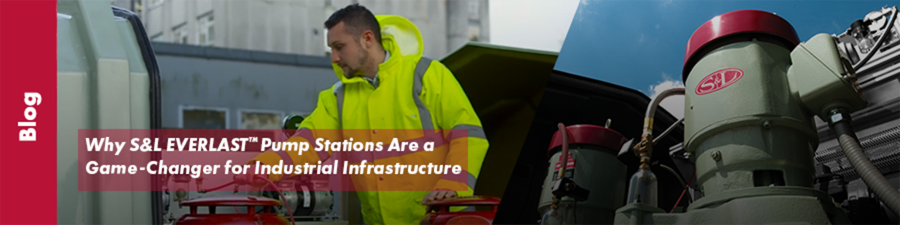
Industrial pump stations manage and transfer process wastewater, storm water, and sewage around and out from industrial facilities like refineries, manufacturing plants, and retail outlets.
These systems handle flows up to thousands of gallons per minute with fluids containing solids up to three inches in size.
Industrial facilities generate more than just multiple "water" streams. Whether it’s high-strength process waste, domestic sewage from a large workforce, or stormwater, managing these flows with industrial wastewater pump stations is a high-stakes responsibility.
In environments like chemical plants and petroleum refineries, water management is an environmental mission. Every drop of rain that hits a process pad must be captured and treated to prevent hydrocarbons from reaching groundwater. This is where the Smith & Loveless EVERLAST™ Series shifts from "equipment" to "environmental security."

Beyond the Basics: The "Triple Threat" of Industrial Wastewater
Many industrial sites require a pump station capable of handling three distinct challenges:
- Process Wastewater: Corrosive, high-temperature streams from manufacturing and CIP (Clean-in-Place) cycles.
- Domestic Sewage: Standard sanitary waste from facility restrooms and breakrooms.
- Industrial Stormwater: Rainwater runoff that picks up oils and debris. This "contact water" must be pumped to onsite treatment or municipal collection systems to prevent accidental discharge into local ecosystems.
Three Critical Considerations for Facility Managers & HSE Engineers
1. The HSE Priority: Eliminating Confined Space Hazards
For Health, Safety, and Environmental (HSE) managers, the biggest risk factor in wastewater pumping is confined space entry into sumps, wet wells, and valve vaults. Traditional submersible pumps require technicians to enter wet wells or valve pits for inspection and service—environments that are often oxygen-deficient or contain H2S toxic fumes. Wet wells can exceed 15 feet in depth, introducing significant fall hazards.
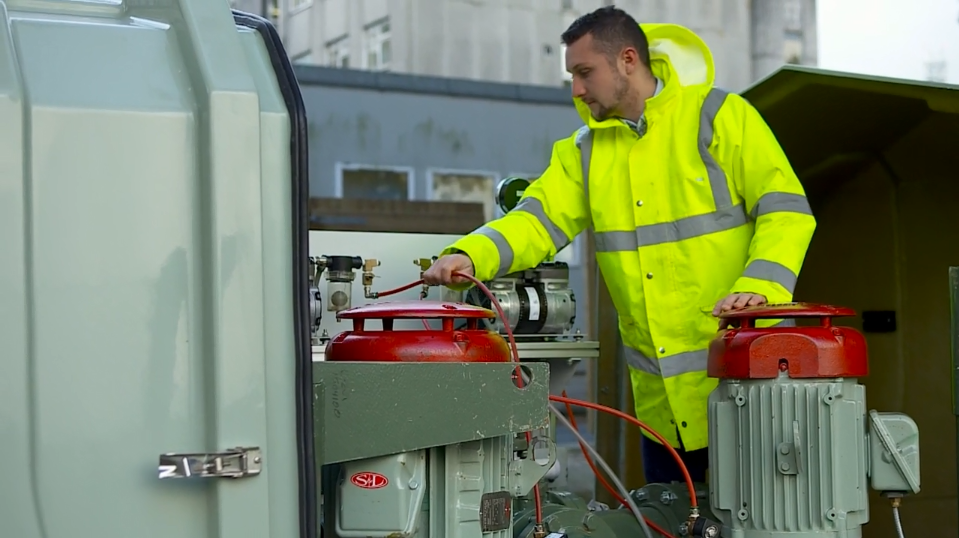
- The S&L EVERLAST™ zero-entry advantage: The above-ground approach virtually eliminates the need for confined space entry during routine maintenance and operation.
- No Permits, No Risk: Because the pumps, motors, and control valves are located at ground level in a clean, lighted enclosure, you remove the need for:
- "Permit-Required Confined Space" protocols.
- Air quality monitoring, tripods, and safety harnesses for inspections.
- The inherent risk of falls or chemical exposure in a wet well or valve vault.
It should be noted that Smith & Loveless can provide Class I Div II enclosures when necessary. Many suppliers have third parties provide these types of enclosures, and that can be costly and complicated.
See how facilities are upgrading from traditional submersibles:
Watch the Submersible Swapout Animation.
2. Mechanical Reliability for Stormwater Containment
At a petroleum or chemical refinery, stormwater management is about surge capacity and nonstop reliability.
- The S&L Solution: S&L Non-Clog Pumps feature oversized stainless steel pump shafts, heavy-duty bearings, and optional exclusive mono-port impellers designed to deliver long-lasting, reliable daily performance – up to 20-30 years with basic TLC. These pumps are engineered to handle grit and hydrocarbons common in refinery runoff. EVERLAST™ pump stations remain primed and ready to evacuate the sump the moment a storm surge begins, ensuring environmental protection. Pumping capacities start at 75 GPM and expand to 1,500+ GPM for a single duplex pump station.
3. Long-Term Durability in Aggressive Environments
Industrial process wastewater isn't just dirty; it is often chemically aggressive.
- Dry-Run Protection: Unlike submersibles that sit immersed and eventually deteriorate, the EVERLAST™ mechanical components remain dry and accessible above-ground. This extends equipment life significantly—often by three to four times—compared to pumps submerged in potentially corrosive fluids.

A Legacy of Versatility: From Local Industry to Federal Infrastructure
When you choose a wastewater solution, you aren't just buying hardware; you are investing in the experience of a company that has worked across every sector of the global economy. Smith & Loveless Inc. brings 80 years of pump station engineering excellence to industry:
- Industrial plants and refineries in the oil and gas, power, chemical/petrochemical, food and beverage, and mining sectors.
- Federal & Military Facilities: Providing "battle-tested" reliability for the U.S. Military, the National Park Service, and more.
- Commercial facilities: Supporting the infrastructure of travel centers, manufacturers, and major retailers.
- Public Works: Keeping thousands of municipalities in compliance with high-performance pumping.
The Bottom Line
Whether you are managing brewery effluent, refinery sewage, or hydrocarbon-heavy stormwater, the pump station is your first line of defense. By choosing an above-ground, vacuum-primed solution, you are selecting a safer, more efficient, longer-lasting, and environmentally secure future for your facility.
Explore Real-World Results:
Start by reviewing our proven installations in the Case Studies section, then dive deeper into pump station design, reliability, and safety strategies in our technical resource library.