


Most people give little thought to wastewater once it goes down the drain. However, a generation of consumer products engineered never to break down has quietly created one of the costliest infrastructure challenges in water industry history.
As utilities face an evolving waste stream, operators are learning that the most effective response is not simply a better macerator. It is a smarter, systems-level strategy.
The Evolution of a Collection System Crisis
The crisis took root in the early 2000s with the ubiquity of industrial-strength shop wipes, baby wipes, and disinfecting wipes designed to resist water breakdown. Because they pass through home toilets without clogging, they are marketed as "flushable." Downstream, however, they present a massive operational challenge.
Today, the debris mix continues to shift:
- New Contaminants: Pandemic-era PPE and vape cartridges now frequently clog pump stations.
- Demographic Shifts: New residential subdivisions can overwhelm decades-old systems overnight.
- Higher Solids Ratios: The widespread adoption of low-flow toilets means less water is carrying the same heavy debris load.
While public education and federal labeling legislation help, operators still must manage whatever enters the system.
Grinding vs. Passing: Thinking Beyond the Immediate Clog
More recent responses to pump clogging have focused on solids reduction through macerators and grinders placed at or near pump stations. While these cutting mechanisms have a role in controlled environments like hospitals or prisons, their downstream consequences in municipal systems can be severe.
A macerator at one lift station may clear the immediate clog, but the finely shredded material can simply conglomerate at the next wet well.
Furthermore, finely ground material can bypass headworks screening and enter biological treatment processes, aerators, and process pumps. This moves the problem to systems that are far more costly and disruptive to service than a lift station pump.
A more strategically sound approach is to pass larger solids intact through the collection system so they can be captured cleanly by existing headworks screens.
Rethinking the Impeller: Efficiency Without Compromise
To pass solids intact, the pump itself must handle them reliably. Traditional multi-vane impellers feature multiple flow passages where fibrous material frequently wraps, braids, and seizes the pump.
To solve this, Smith & Loveless developed the X-PELLER® impeller. Built around a patented mono-port design, it creates a single, large solids passage that forces material through cleanly without recirculation.
- Proven Results: Field tests in high-clog applications, including schools, prisons, and retail centers, virtually eliminated clogging.
- No Efficiency Tradeoffs: Unlike historical mono-port designs, the X-PELLER® minimizes turbulence, radial load fluctuation, and vibration, helping protect seals and bearings from premature wear.
Above-Ground Design as an Operational Strategy
Smarter solids management extends to lift station configuration. Traditional submersible stations require technicians to pull heavy, rag-dressed pumps from deep wet wells, creating a slow, hazardous, and costly maintenance process.
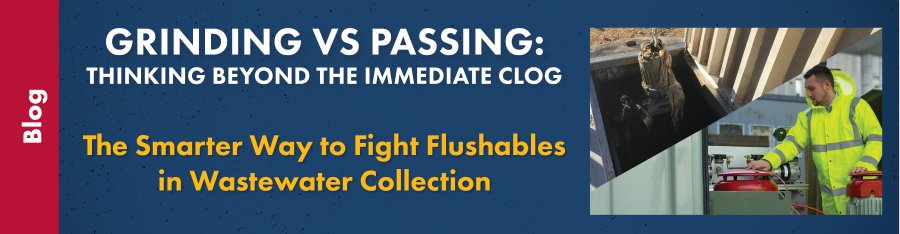
Above-ground lift station designs, such as the Smith & Loveless EVERLAST™ platform, position pumps, valves, and mechanical components entirely above the wet well.
Traditional Submersible vs. Above-Ground EVERLAST™
Traditional Submersible: Pulling heavy, contaminated, tightly constructed pumps from wet wells.
Above-Ground EVERLAST™: Safe, dry, visual inspection in seconds and access to the pump impeller in just minutes.

This design shift delivers distinct operational advantages:
- Operator Safety: Eliminates routine confined-space entry; maintenance can often be handled by a single technician.
- Upstream Mitigation: Elevated suction pipes draw from outside the mid-column zone where floating debris concentrates, reducing clog risks before material reaches the pump.
- Quicker Valve Access: While traditional valve vaults can require hours of labor to clear with multiple staff in confined-space required safety gear, the integrated RapidJack® check valve allows a single operator to access and clear valves in minutes at safe ground level without piping disassembly.
An Integrated Solution
With shrinking budgets and tight labor markets, reactive, station-by-station responses to clogging are no longer sustainable.
The most effective strategy combines system-wide solids management, advanced impeller technology that maintains hydraulic efficiency, and above-ground infrastructure designed for operator safety. By partnering with a provider who understands the entire wastewater lifecycle, from collection to treatment, utilities can implement solutions built for real-world resilience.